


Every Force Dynamics simulator is custom-built to your specific needs. Please contact us, and one of our experts will reach out to you (no obligation) to discuss the best setup for you.
- Platform only: ~$30,975
- Full package ready to run: ~$42,095
The 202 is the only true motion simulator in its price and size class; the only in the class capable of moving displays with the chassis, the only one providing true g-force loads, and the only two-actuator system with effective surge and sway axes that outperform professional-level 6DOF systems.
The 202 stands in a class of its own - at any price.
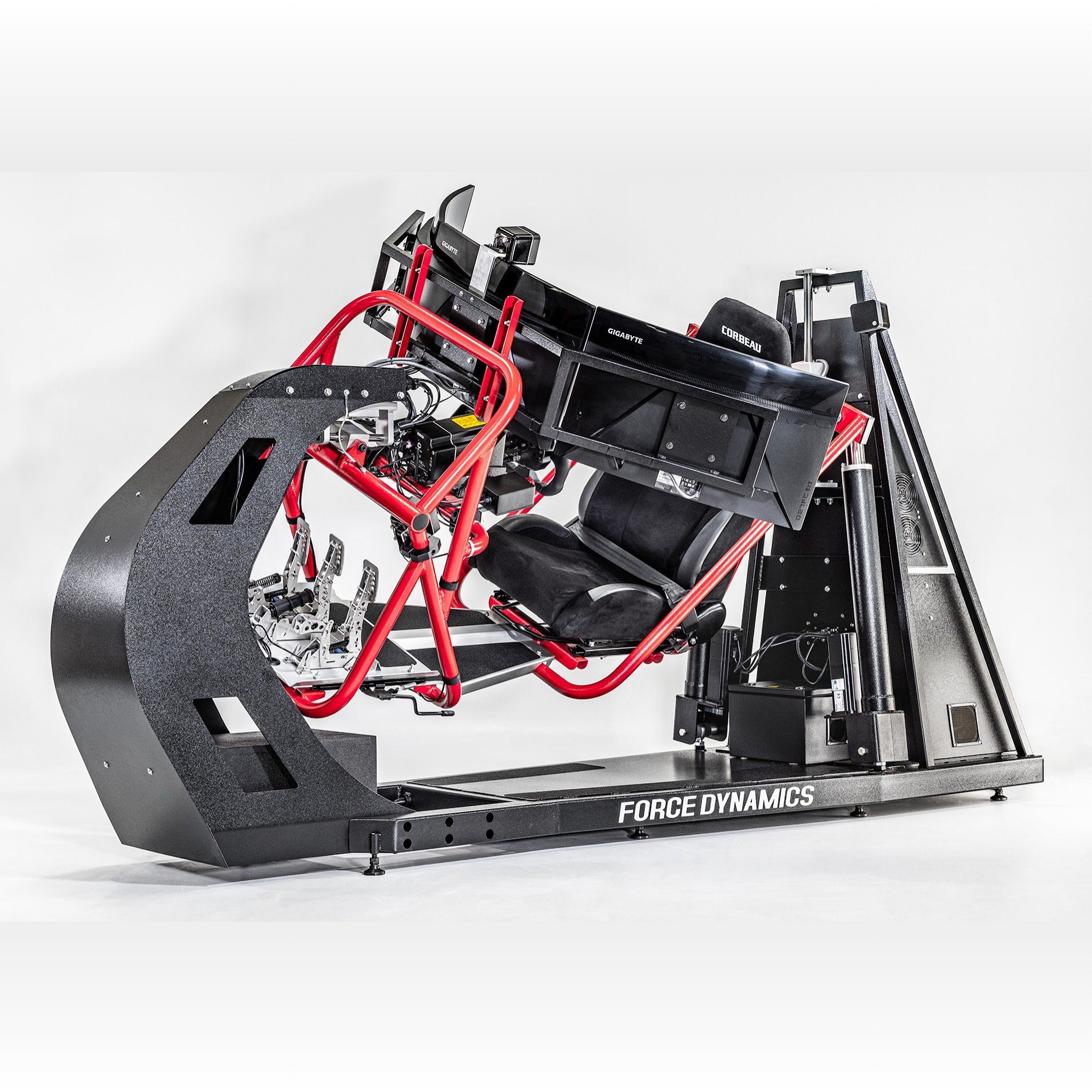
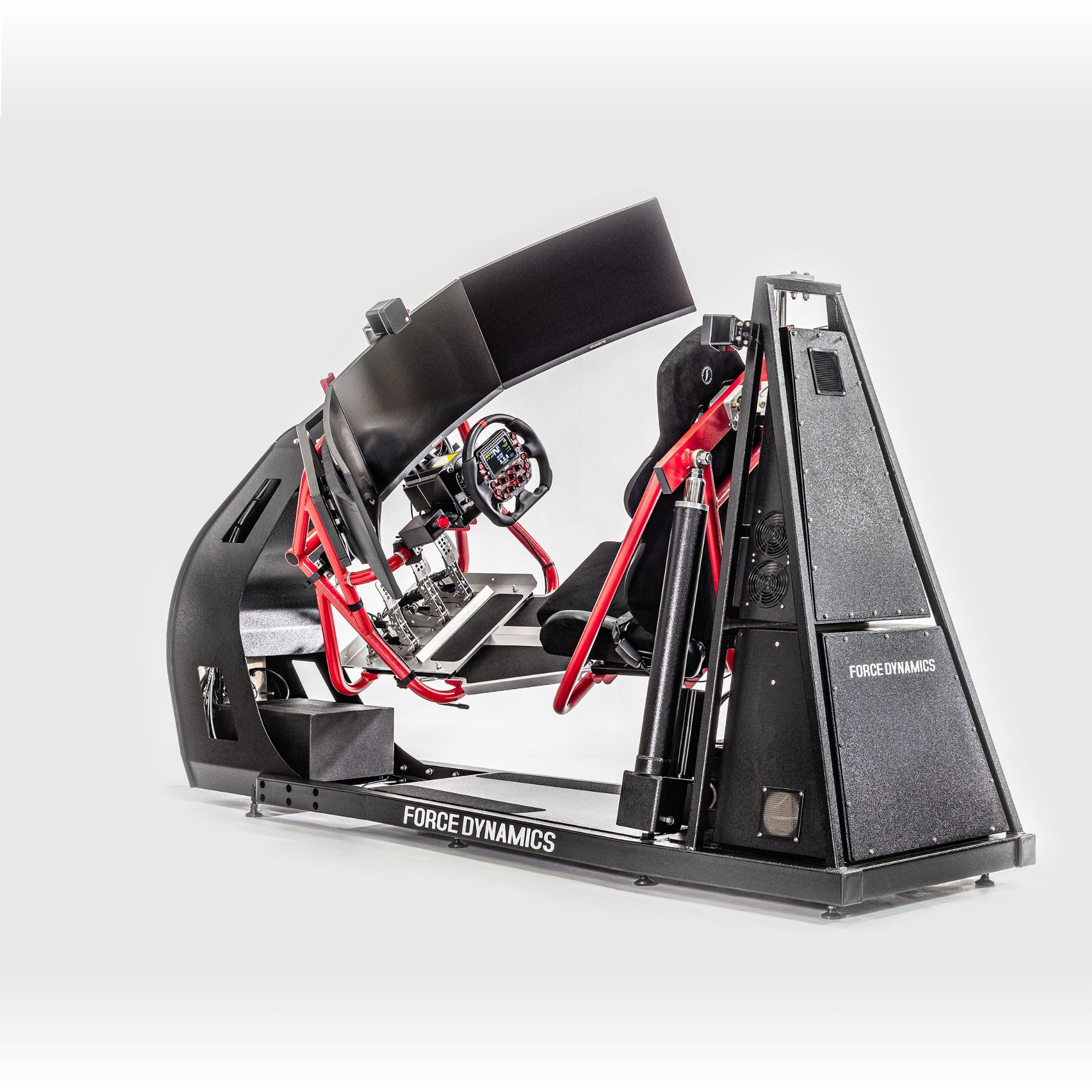
The Force Dynamics 202 is a complete racing simulator package built on the same compact 3-axis motion platform as the 202, but delivered with everything needed to start driving immediately. Each platform is custom made with the Platform Only model designed for integrators who want to customise the platform themselves and the Ready To Run option which includes everything for use out of the box. displays, direct drive wheel, pedals, seat, audio, and gaming PC — configured and tested by Force Dynamics before shipping.
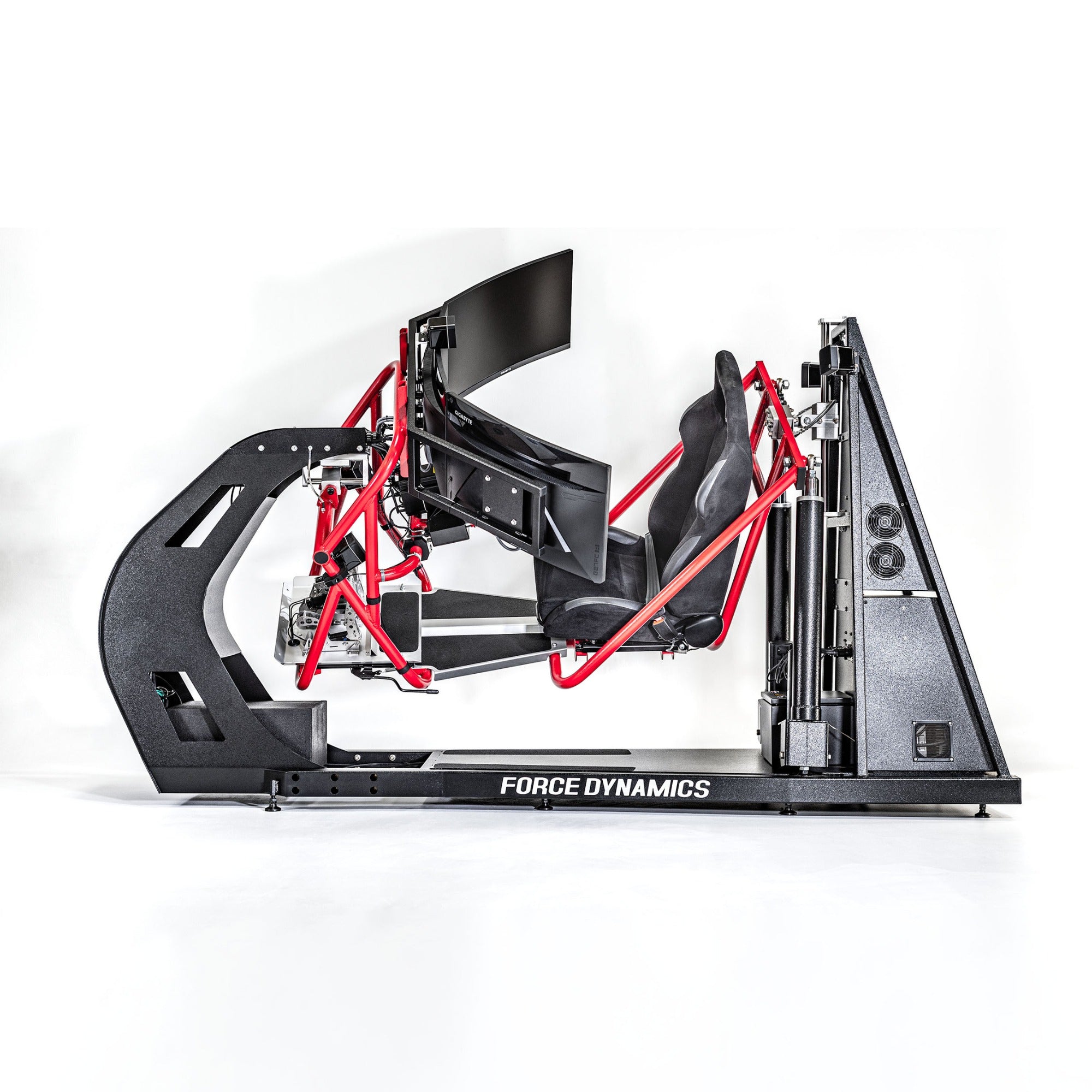
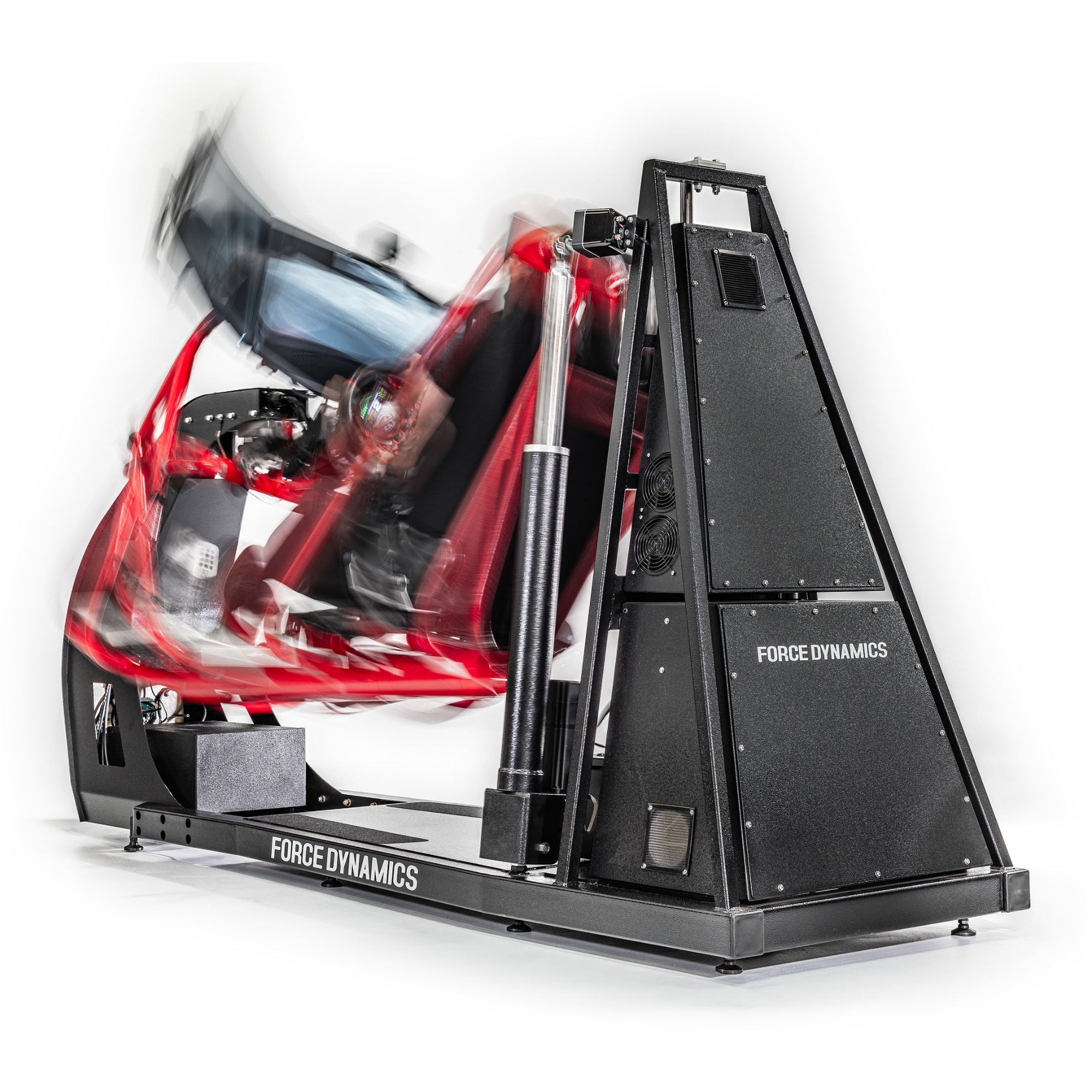
The 202 motion platform delivers genuine g-load simulation in a package small enough to roll through a standard interior doorway. Roll rates exceeding 120 degrees per second with acceleration above 11,500 deg/s² provide the kind of sustained lateral g-force feedback most platforms can’t achieve at any price. The combined pitch-heave axis delivers up to 15 inches of vertical travel at over 5g, simulating braking deceleration and vertical road texture in real time.
Detailed Design Rationale
How Motion Simulation Works
You perceive accelerations via your inner ear, where fluid moves as you accelerate or tilt. Your brain uses visual cues to interpret whether that sensation means you're lying on your side or cornering at 1g.
Motion simulation exploits this ambiguity. By tilting your inner ear to create the physical "you're cornering" signal while showing your eyes a visual "you're cornering" cue, your brain interprets the tilt as cornering—not rotation.
The Challenge of Different Axes
Cornering forces transition gradually. Even Formula cars take a few hundred milliseconds to shift from hard left to hard right cornering. This gives a well-designed motion platform enough time to complete the physical rotation needed to model the acceleration change.
Braking and acceleration present a bigger challenge. Their onsets are much quicker—especially braking, which can go from zero to full force in milliseconds. Pivoting mechanical hardware that rapidly is difficult and expensive. The pitch axis also consumes more space (humans aren't spherical) and costs more to control and actuate.
Force Dynamic's Solution
Manufacturers respond to this challenge in two ways: give up (build a four-post rig or seat mover), or maximize fidelity on the most useful axes while deliberately sacrificing nominal performance on others.
The 202 takes the second approach. Its geometry maximizes performance on the roll axis—the easiest to cue correctly and one of the most important for useful g-load feel. It compromises on the pitch axis, which is tricky to implement well and carries disproportionate cost in power and space requirements.
Deliver times
Delivery times are approximately 10-14 weeks, depending on the configuration. Faster delivery can sometimes be accommodated depending on the specifications and inventory availability.
Commercial & Residential options
Force Dynamics platforms can be configured for commercial and residential applications.
Features
- Complete package — Triple displays, direct drive wheel, load cell pedals, seat, audio, and gaming PC all included.
- Genuine g-load simulation — Roll range exceeding 30 degrees provides real, sustained lateral g-forces.
- Ultra-fast servo response — Roll slew rate of 120 deg/s, acceleration over 11,500 deg/s².
- 15-inch combined pitch-heave axis — Braking, acceleration, and vertical road feel at over 5g.
- Compact footprint — Fits through a standard interior door fully assembled.
- ForceControl software — Supports 80+ simulation titles including iRacing, Assetto Corsa, rFactor 2.
Performance comparisons
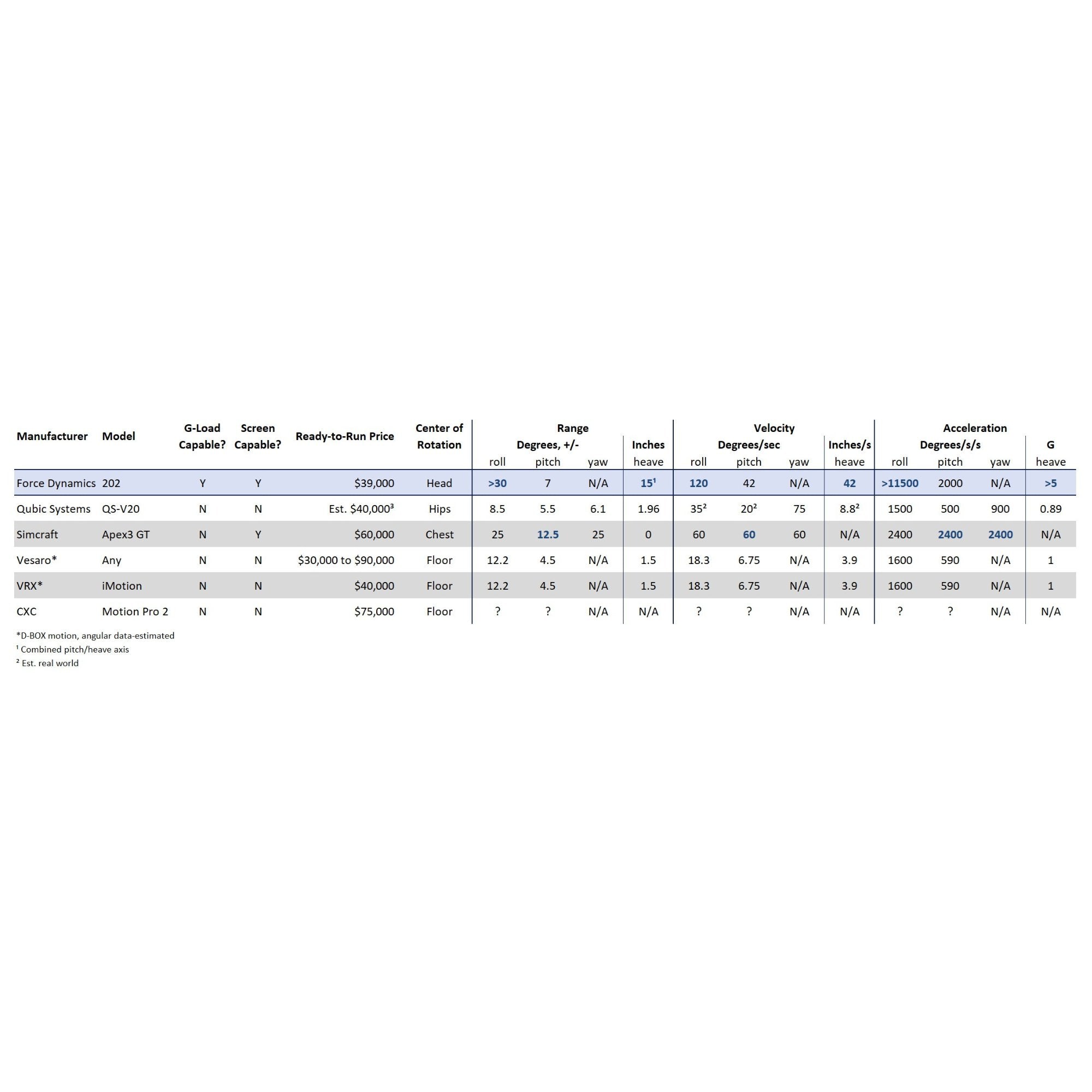
- >5x actuator acceleration vs D-BOX
- 10x actuator velocity vs D-BOX
- 10x roll-axis acceleration vs four-post rigs
- >10x dynamic performance vs Qubic, Vesaro, & VRX
- 2-6x roll velocity vs Simcraft, Qubic, Vesaro, & VRX
- >5x roll accelerations vs Simcraft

Five-Axis Performance from Two Actuators
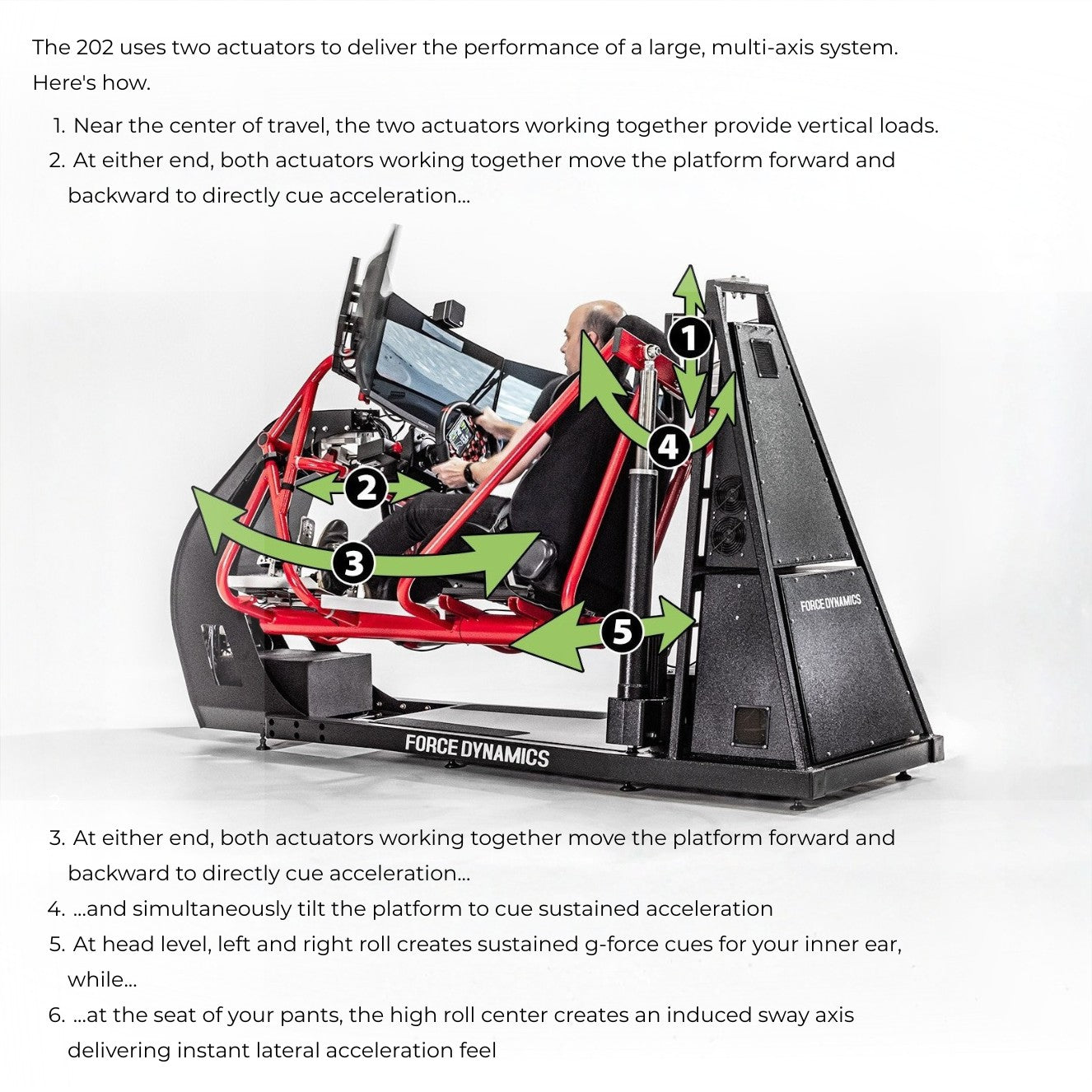
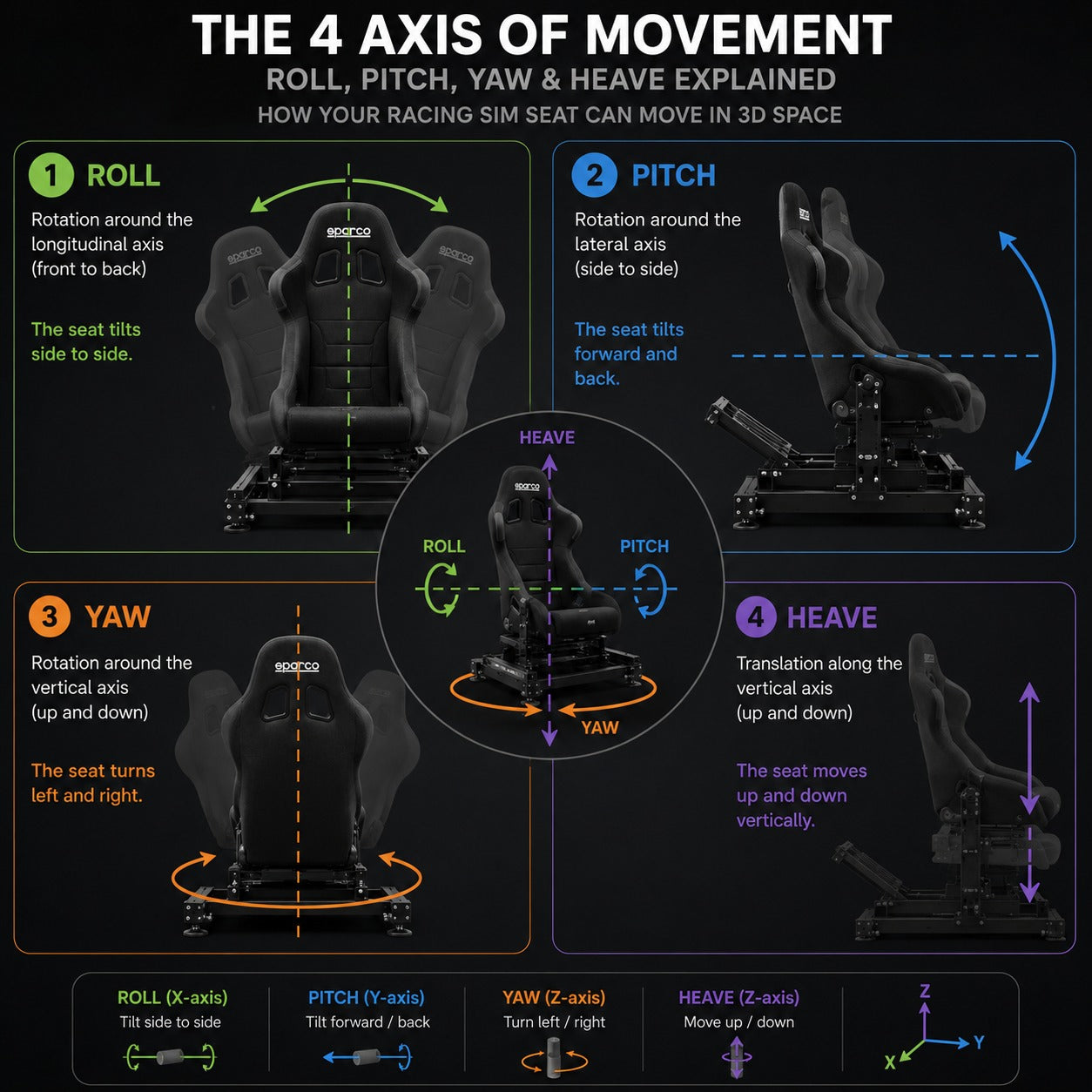
The 202 is nominally a two-axis system, but its geometry creates five effective axes of motion.
Roll + Induced Sway: The two actuators working in opposition roll the platform. The ultra-high center of rotation means the seat moves laterally more than twenty inches. This behavior is equivalent to a sway axis on a large 6DOF system—roll and sway both cue lateral load, and are always actuated together.
Heave: When both actuators work together during center travel, the seat moves up and down, providing a large-range heave axis.
Pitch + Induced Surge: Toward the end of travel—under braking or heavy acceleration—the platform pitches around the front axis (delivering acceleration cues) and moves fore and aft. This creates an induced surge axis nearly as large as the independent surge axis on systems costing three to four times as much. The platform's geometry blends this seamlessly with pitch to deliver the loads you'd expect from a dedicated multi-axis platform.
In the box
Platform Only
| Motion Platform | Force Dynamics 202 motion platform (3-axis: roll, combined pitch-heave) |
| Power | 120/240VAC power supply |
| Does not include | steering wheel, pedals, shifter, seat, harness, display, PC and audio |
Ready to Run package
| Display | Triple curved 27-inch LCD displays |
| Audio | 600W 2.1 sound system (300W subwoofer + 100W satellites) |
| Steering Wheel | RS wheel rim + Moza R16 direct drive wheelbase |
| Pedals | Heusinkveld Sprint pedals with clutch |
| Seat | Corbeau Forza seat |
| PC | Integrated gaming PC |
| Software | ForceControl software licence |
Add-on/upgrades
These are just some of the upgrades we offer. All platforms are custom-built to your specifications:
| Audio | 900w 5.1 audio |
| Seat | Corbeau A4 seat |
| Steering wheel | Simucube Sport + GSI GT-MAX32 & other options |
Specifications
| Motion Axes | 3 (Roll, Pitch/Heave combined) |
| Roll Range | >30 degrees |
| Heave Range | 15 inches (38 cm) |
| Roll Velocity | 120 deg/s |
| Heave Acceleration | >5g |
| Power | 120/240VAC single phase |
| Price | Approx range: $30,975 to $42,095 |
Static Performance (Layout)
| Reduced Size | The 301 and 401cr are too large to fit through a standard door, and difficult to assemble without expert assistance. The 202 is narrow enough to fit through a standard interior door fully assembled, and is not difficult to disassemble if necessary to allow for manual transport |
| High Center Of Rotation | Center of rotation is one of the most critical simulation specs. A low rotation center will cause ‘parasitic forces’ at head level, swinging your head in the opposite direction of the intended acceleration cue at the start of every movement. Four posters’ centers of rotation are literally under their floors, so low that they’re almost useless for conveying g-loading information. Some others manage chest-level CoR. The 202 is head level for its primary roll axis and chest level for pitch, providing unparalleled lateral load feel during sustained cornering and allowing us to fully exploit its huge roll range without any parasitics or false cues |
| Reduced Servo Load | Weight is the enemy of performance in race cars and in simulators, and with a lower-cost simulator, reducing weight is even more critical. Lifting the entire moving group is expensive and difficult, which is why most manufacturers don’t even bother. This disconnects visual from motion, drastically limiting cueing options and motion fidelity. Disconnected displays are a nonstarter for us, so hanging the moving group off a suspended point just behind the display system serves both to raise the center of rotation (compared to a front floor pivot) and to suspend a big chunk of weight (the wheel base, wheel, front audio, pedals, and displays) so its mass doesn’t affect the machine’s performance. |
Layout Benefits
| Reduced servo load (as above) | Less weight on the servo system means more performance. |
| Increased performance | Changing accessory loads has little effect on performance with a suspended central pivot. You can put a 50lb wheelbase on the 202 with only the tiniest effect on performance, and even large displays will only affect roll axis performance insofar as they increase polar moment of inertia, rather than constantly loading the servo system. |
| Reduced wear | Most wiring, displays, audio, and controls will barely move even when the driver is pounding through Eau Rouge or hurtling up a gravel stage on Rally Finland, increasing lifetimes of the most delicate system components. |
| Context-Cueing | With only two actuators, we don’t have fully-separate control over pitch and Z events. But with a carefully-chosen layout, we can provide a compromise position that provides each cue and blend them in software depending on context. In the 202, we use negative pitch for acceleration, but bleed off that pitch cue as braking g-loads are incurred, because that tends to feel more like a vertical movement. As we do that, we blend in vertical cues, so the end result feels much more like a 3-axis (or greater!) system than a 2-axis system. |
| An effective multi-axis system | Our roll center of rotation is ideal, but the pitch center isn’t — as mentioned above. The geometry we chose has an answer for this, though: As the platform lifts and pitches up, it shifts backwards along a slider located on the front pivot axis. Get on the brakes and you shift backwards; get on the throttle and you shift forward. What's more, the high center of rotation means that where it matters, at the seat of your pants, you move a huge ± 12 inches side to side during cornering: More than all but the largest professional 6DOF platforms! |
Manuals & Instructions
Choose options